
- Published on
Why My MRR Battle Startup Failed
- Authors

- Name
- Salman
- X
- @lamebrowndev
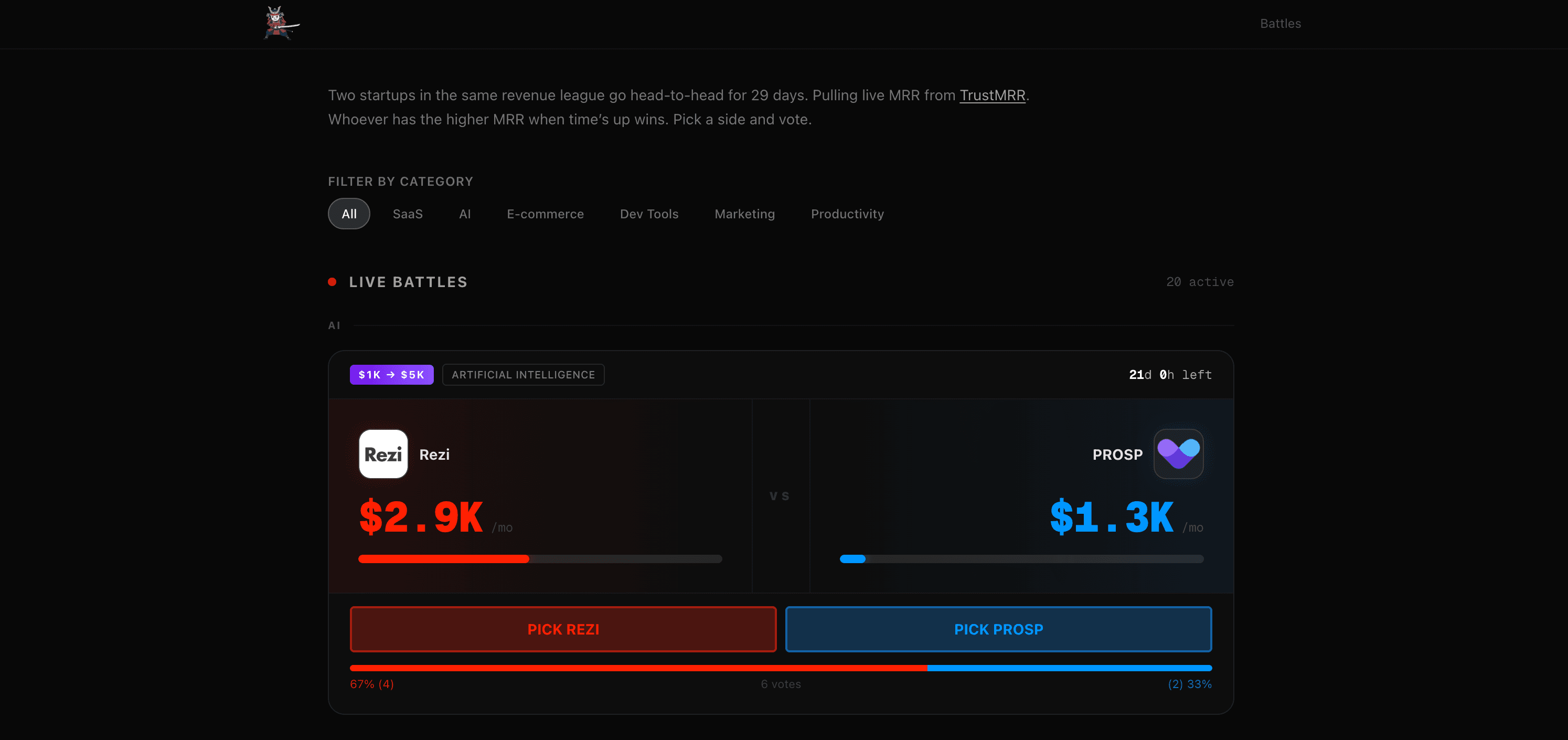
whowinsmrr.com failed this week. Not with a bang, with a quiet realization that the thing I’d built had no path to the people it was meant for.
The Idea
whowinsmrr.com was simple in concept: two startups in the same MRR band go head-to-head in a 29-day battle. Revenue data came from TrustMRR, real MRR, not self-reported fluff. Visitors saw active battles, voted on who they thought would finish ahead, and at the end we crowned the winner: whoever had higher MRR when the clock ran out. Votes were predictions, not popularity contests. The outcome was decided by the numbers.
Under the hood, a daily cron on Vercel pulled fresh MRR, stored snapshots, closed finished battles, and spun up new ones. Same league, fair fights. The idea was to make startup growth visible, competitive, and a bit fun, like fantasy league for MRR.
Why It Died
1. No Audience, So Everything Rode on Virality
I don’t have an audience. No email list, no following, no distribution channel. So the only way the app could get traction was if it went viral, if people shared battles, argued in comments, sent links. It didn’t. Virality is a strategy, not a guarantee. Building something that requires virality when you have zero audience is building on hope. Hope isn’t distribution.
2. I Didn’t Have a Clear Picture of What the App Would Be
Was it a prediction game? A leaderboard? A way to discover startups? A growth benchmark tool? I could’ve answered “all of the above,” which is another way of saying “none of the above.” The core loop was there, vote, wait, see who won, but the why for the user was fuzzy. When you can’t explain in one sentence what someone gets from using it, you don’t really know what you’re building. I didn’t.
3. Limited Budget for Marketing
I had almost no budget to put behind it. No paid acquisition, no real campaigns, no way to buy attention while the product found its legs. That’s fine when you have organic distribution or a clear wedge. I had neither. So the app sat there, technically working, with no engine to get it in front of people. You can’t rely on “build it and they will come” when “they” don’t know you exist.
What I Learned
Virality is a multiplier, not a plan. If you have no audience, you need either a product so sharp it compels sharing, or a way to reach people that doesn’t depend on luck. I had neither. Next time: build audience or distribution before the product, or build something that doesn’t need to go viral to survive.
Clarity of purpose comes first. “Startups battle by MRR” is a mechanic. “So you can…” is the product. I had the mechanic. I never nailed the “so you can.” One clear job-to-be-done beats three half-formed ones.
No distribution + no budget = no launch. A working app that nobody sees isn’t a startup; it’s a side project. Marketing isn’t optional when you have no built-in reach. Either find a channel (community, content, partnerships) or accept that you’re building for yourself.
What worked? From all the things that failed...
The stack worked. TrustMRR gave real data. The cron did its job. Battles ran, closed, and new ones appeared. The failure wasn’t technical, it was strategic. I know what I’d do differently: define the product in one sentence, secure one distribution channel before launch, and never bet the whole thing on virality when I have zero audience.
So I’m shutting down whowinsmrr.com. Not because the idea is bad, but because I didn’t give it a real chance, no audience, no clarity, no way to reach people. That’s on me. Next one, I’ll fix that.